

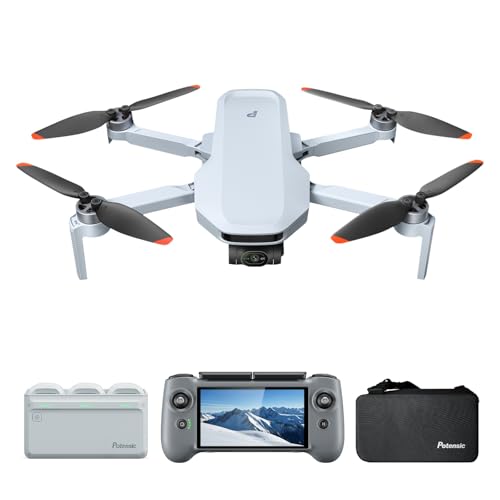
Potensic ATOM SE GPS Drone
Brushless motors and wind resistance support steadier flying. Battery storage behavior can be inconvenient if you fly only occasionally
Best overall: Potensic ATOM SE GPS Drone. We compared 14 drones using current price, editorial assessment, and buyer feedback.
The ranking weighs current price, editorial assessment, useful technical data, and buyer feedback.
Brushless motors and wind resistance support steadier flying. Battery storage behavior can be inconvenient if you fly only occasionally

Brushless motors and prop guards support calmer, more forgiving flights. The advertised flight time is split across two batteries, not one long session.

Three batteries and 96 minutes total flight time improve session length. The model leans on convenience and portability more than specialized pro-flight features.
Potensic ATOM SE GPS Drone wins on Flight safety and control and Regulatory and weight fit; the final gap is 0.4 points over 100.
Potensic ATOM 2 pushes back on Camera and stabilization, but it does not offset the overall score gap.
Potensic ATOM SE GPS Drone stays first because it combines the ranking score, current price, and comparable category signals better than Potensic ATOM 2.
Potensic ATOM SE GPS Drone wins on Ranking score and Regulatory and weight fit; the final gap is 4.0 points over 100.
Bwine F7MINI 4K-3B pushes back on Camera and stabilization, but it does not offset the overall score gap.
Potensic ATOM SE GPS Drone stays first because it combines the ranking score, current price, and comparable category signals better than Bwine F7MINI 4K-3B.
Potensic ATOM SE GPS Drone wins on Ranking score and Camera and stabilization; the final gap is 7.0 points over 100.
Holy Stone HS175D pushes back on Flight safety and control and Regulatory and weight fit, but it does not offset the overall score gap.
Potensic ATOM SE GPS Drone stays first because it combines the ranking score, current price, and comparable category signals better than Holy Stone HS175D.
Potensic ATOM SE GPS Drone wins on Ranking score and Camera and stabilization; the final gap is 4.7 points over 100.
Dazlen P100 pushes back on Flight safety and control and Price value, but it does not offset the overall score gap.
Potensic ATOM SE GPS Drone stays first because it combines the ranking score, current price, and comparable category signals better than Dazlen P100.
Potensic’s ATOM SE makes the most sense for a first-time drone buyer who wants a light travel-friendly camera drone without stepping into a heavier registration burden. The appeal is clear enough: under-250g weight, two batteries, GPS return-to-home, and a 4K camera give it real range for learning, casual aerial clips, and weekend outings. The trade-off is just as clear, though, because this is still a compact two-axis camera drone rather than a more advanced stabilized creator rig.
If you want a travel-friendly camera drone that does more than basic hover-and-shoot, the ATOM 2 lands in a very appealing lane. The under-249 g frame, 3-axis gimbal, 4K video, 48 MP stills, and included three-battery bundle make it relevant for first-time pilots and content creators who want stabilized footage without carrying a heavier rig. The trade-off is that this is still a compact drone built around convenience and image quality, not obstacle sensing or outright speed.
If you want a compact camera drone that keeps the beginner route simple while still giving you stabilized 4K footage, the Bwine F7MINI 4K-3B lands in a very practical sweet spot. Its sub-249 g weight, 3-axis gimbal, GPS return-to-home, and included three-battery kit make it especially relevant for travel, casual aerial filming, and first-time pilots who want less setup friction and more flying time. The trade-off is that this is still a lightweight mini drone, so it is best for buyers who value convenience and portability over full-size drone confidence in rough conditions.
If you want a beginner-friendly GPS drone that gives you a screen on the controller instead of forcing a phone into the setup, the Dazlen P100 is aimed at exactly that lane. The built-in 4.5-inch LCD, GPS return-to-home, brushless motors, and foldable body make it a practical travel-and-learn option for casual aerial video, but the real trade-off is that it reads more like a smart starter drone than a serious creator rig.

The HS175D makes the most sense for a first-time drone buyer who wants GPS safety, a folding body, and a camera that can handle family outings or roofline checks without jumping straight to a pricier creator rig. Its appeal is the mix of 4K video, auto return, and two batteries in a lightweight package, but the trade-off is just as clear: this is a beginner-friendly flying camera, not a stabilized cinematic drone.
The ranking compares published products with a stable framework: editorial quality, buyer signals, current price when the preset requires it, and comparable category metrics. It does not claim original lab testing; it documents how available signals are weighted so the order remains auditable.
Setup: Collect published reviews, current product data, and comparable technical fields.
Measured variable: Coverage for current price, rating, local review URL, and primary category metrics.
Evaluation rule: Only updated products with enough comparable data can enter.
Setup: Cross editorial score, buyer signals, and price when the preset requires it.
Measured variable: Normalized ranking score on a traceable 0-100 scale.
Evaluation rule: The winner must sustain a stronger balance than the finalists, not just one isolated metric.
This ranking is refreshed from published reviews, current category catalog signals, editorial scoring, and current price. Scores are calculated against the eligible category universe; the visible top only shows the models that pass the final cut.
Descending order: the winner has the strongest balance of Q_final and normalized price against the eligible category universe.
Buyer signal uses the scoring v2 Bayesian score; it is not a simple stars times two conversion.
Computed against eligible comparable category candidates, not only against the visible top. P05=128.99; P95=1313.0.
If a critical axis falls below the threshold, final quality is penalized so one weak product cannot win only on price.
| DJI Neo | 76.0 | Camera and stabilization: 7.3/10. | Battery and range confidence: 5.8/10. |
| DJI Neo 2 Motion | 66.7 | Portability and ecosystem: 7.3/10. | Camera and stabilization: 6.6/10. |
| DJI Mini 4K Fly More Combo | 66.4 | Camera and stabilization: 7.8/10. | Portability and ecosystem: 6.7/10. |
| DJI Mini 5 Pro Fly More Combo Plus | 64.9 | Camera and stabilization: 8.8/10. | Regulatory and weight fit: 6.5/10. |
| DJI MT2SD | 62.8 | Camera and stabilization: 7.8/10. | Battery and range confidence: 5.5/10. |
It does not mean choosing the cheapest product by default. The ranking crosses editorial score, buyer satisfaction, useful technical data, and updated price to identify the model with the most defensible balance.
The page prints the latest available refreshed price to make comparison clearer, but Amazon can change price and availability at any time. The live purchase link remains the final check before buying.
Yes. The preset ranking keeps the editorial frame, URL, and components stable while recalculating internal positions when comparable data changes or new models enter the catalogue.
The ranking is not meant to list the whole catalogue. A model first needs a published review, a current price, and comparable signals; then only the set that clears the operational cut is ordered. A product can stay outside the visible top when its price is stale, it has no public URL, its useful data is incomplete, or its balance of quality, user signal, and price remains weaker. This keeps the same freshness gate used across the rest of the site.