Top 5 best value action Cameras (August 2026)
Compare value action Cameras with updated prices, editorial scores, technical data, and buyer satisfaction before choosing.
- 1
- 2
- 3
10 Models reviewed
Reviews and comparisons for Action Cameras, focused on video and image quality, stabilization and field of view so you can choose by use case and budget.
Compare value action Cameras with updated prices, editorial scores, technical data, and buyer satisfaction before choosing.
These shortcuts come from the category's active use cases and stay in sync with each cohort analysis block.
Practical snapshot of Action Cameras: current prices, documented specs, and the axes where reviewed products differ most.
Ranking computed with the editorial score specific to this category.
Search by text, sort products, and surface the key features that matter most to you.
9 products
No products match that search or filter combination.
Quick comparisons
Select 2 products to see the comparison in this section.
No products match that filter combination.
Use-case analysis
This section separates 360 camera within Action Cameras. Cameras built for full 360 capture, reframing, invisible selfie-stick style shots, or immersive footage. The selection is hydrated from published reviews, current price context and editorial scoring.
Insta360 X5
Native 360 video · Image stabilization
Insta360 X3
Native 360 video · Waterproof body
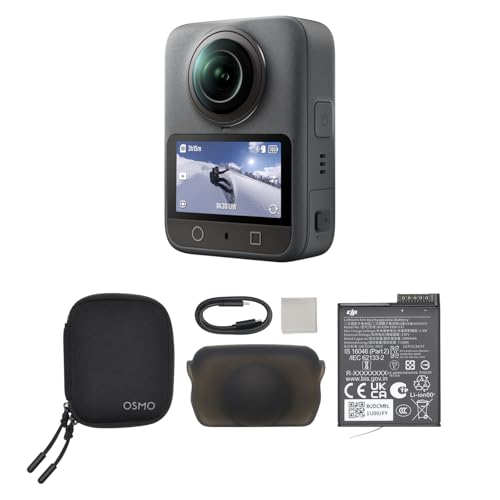
DJI Osmo 360 Standard Combo
Native 360 video · Built-in storage
Updated: 2026-08-08 01:48 UTC
Action cameras split by use case more than by headline resolution. The right pick depends on how well it handles motion, mounting, water, battery swaps, and your publishing workflow as one system.
| Use case | Prioritize | Avoid paying more for |
|---|---|---|
| POV sports rider | Stabilization, wide field of view, secure mounts | Extra megapixels without motion control |
| Water and snow user | Waterproof rating, cold-ready battery, rugged body | Vague splash claims or case-only protection |
| Solo creator | Front screen, audio support, app editing | Accessory kits without better filming workflow |
| 360 shooter | Native 360 capture, reframing workflow, built-in storage | Wide-angle cameras sold as 360 |
| Bundle buyer | Extra batteries, charger, mounts, storage | Low-value accessories that hide a weak camera |
This matters most for helmet, bike, and handheld motion where shaky footage ruins the result.
This matters when you will film in rain, surf, snow, mud, or near impacts and cannot rely on a case.
This matters on trips and long shoots where runtime, battery count, and charging convenience decide usability.
This matters for POV sports because a secure mount is as important as the camera itself.
This matters when you need footage that still looks good after cropping, reframing, or editing.
This matters for vlogging and self-framing because it reduces retakes and setup time.
This matters when you record talking clips, travel updates, or creator content instead of silent action.
This matters only when the extras solve real needs like batteries, mounts, charger, or storage.
High resolution does not help if stabilization, frame rate, or field of view cannot handle action footage.
A big kit can look valuable while the actual camera model, sensor, or capture workflow remains weak.
Some listings need a separate case, so vague water claims can leave you underprotected in real use.
A true 360 camera needs native capture, stitching, and reframing support, not just a wide lens.
A camera that looks strong on paper can fail on a trip if runtime, charging, or card support is poor.
A vlogging camera, POV sports camera, and bundle kit solve different problems, so the wrong route wastes money.
We assess each model by real buyer fit, confirmed specs, current price, availability and visible customer feedback. The recommendation depends on whether stabilization, ruggedness and battery workflow make sense for the way the product will actually be used.
The score is not a generic average: it weights the axes that matter most in this category and combines them with documented specs, current price, and user rating when the sample is useful.
Weight 26%. Resolution, frame rate, sensor size, HDR, bit depth, and photo modes decide whether footage holds up beyond casual clips.
Weight 22%. Action footage depends on stabilization, lens options, horizon lock, and field of view more than resolution alone.
Weight 18%. Waterproofing, cold resistance, mounting ecosystem, and physical durability decide whether the camera fits sports and outdoor use.
Weight 18%. Runtime, battery type, included batteries, charging, SD card support, and built-in storage shape how usable the camera is on a trip.
Weight 16%. Screens, microphones, live streaming, webcam mode, app editing, data overlays, and bundle quality decide whether the camera fits publishing workflows.
Editors keep room to penalize weak documentation, unsupported claims, or practical friction that specs do not capture cleanly. User stars can adjust the final score, but they do not replace the technical evaluation.
A product can move down the list when strong headline specs are offset by weak setup, unclear maintenance, subscription friction, poor portability or accessory-only evidence. We do not treat spare parts, mounts, filters or unclear variants as complete products.
Start with the use case that matches your situation, then compare the specs and trade-offs that affect ownership. Prices, availability and new reviews can change the shortlist as better evidence appears.
For action footage, frame rate is often more important than headline resolution. A camera that records at 4K with a high frame rate usually delivers smoother motion than one that only advertises a higher resolution without fast capture modes.
Very important. Strong electronic or optical stabilization helps reduce shake, and horizon lock can keep the image level during fast turns or rough terrain. For POV sports, stabilization and mount security usually matter more than resolution alone.
It depends on the camera’s stated waterproof rating. If the body is explicitly rated waterproof to a certain depth, it can often be used without a case for that limit; if the rating is unclear, assume a case is needed and do not rely on the listing alone.
Check whether the battery is removable, how many batteries are included, and whether charging is simple for travel or multi-day use. Also confirm SD card support or built-in storage, because storage limits can matter as much as battery life on long shoots.
No. A true 360 camera uses native dual-lens 360 capture and is designed for reframing and invisible selfie-stick style shots, while a regular action camera records a standard wide-angle view. Choose 360 only if the workflow depends on reframing after capture.
A bundle is useful when it includes practical items like extra batteries, a charger, mounts, or storage that improve real-world use. If the accessories are low value or the camera model and capture specs are unclear, the bundle should not outweigh the camera itself.